Last night I watched QI and it was all about happiness. The wonderful thing about QI is that every 30 seconds you have your perceptions challenged. You look at the TV and say “Eh, what, really“?
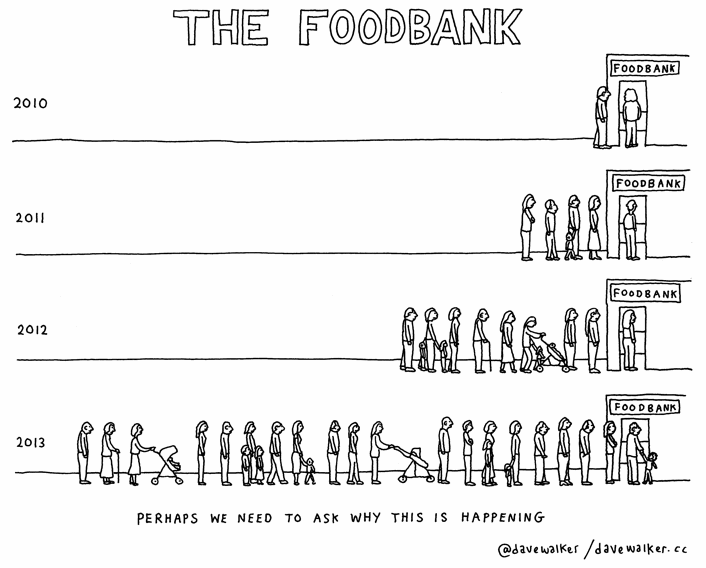
What made me do the double take last night? Stephen Fry said that there is a 10% wider gap between the rich and the poor since John Major’s government. In the long history of humanity, that is a staggeringly small time frame – it is within my lifetime! It was so startling that it made me start looking things up. Surely there can’t be such a gap between the have’s and the havenots. As you can see in the video above, what we perceive to be the distribution of wealth in the UK is very different to the reality.
We live in a world of finite resources and wealth is a relative term. For there to be “rich”, there need to be “poor” because wealth is a relative thing. If we all win the lottery tonight, bread will be sold at £10.50 a loaf in the morning. In my wallet I have a meaningless piece of paper (financially): a million Zimbabwean Dollars, worth less than a single penny. In reality it is one of the most meaningful pieces of paper I have because it illustrates that “wealth” is only “wealth” if it is relative to “poverty”.
There has been a lot of research into the current discrepancies between public perception about benefits and the reality. Perceptions are much more powerful than facts as people tend to view anecdote and narrative highly if it is told to them by people they trust. It came as a great surprise to the last person who told me about “all the scroungers claiming benefits” when I pointed out that he was the only person in the room receiving any benefits. He clearly didn’t see himself as being a benefits claimant.
‘Our data poses real challenges for policymakers. How can you develop good policy when public perceptions can be so out of kilter with the evidence? …First, politicians need to be better at talking about the real state of affairs of the country, rather than spinning the numbers. Secondly, the media has to try and genuinely illuminate issues, rather than use statistics to sensationalise. – Hetan Shah, executive director of the Royal Statistical Society